
15 reasons why Christopher Nolan’s Odyssey is a travesty: A Greek perspective
When it was announced that Christopher Nolan was tackling Homer’s Odyssey as a big-budget blockbuster full of practical effects, the cinematic world rejoiced. After all, this was a filmmaker at the top of his game following the Oscar-winning success of Oppenheimer (2023), and one who has consistently demonstrated his skill at navigating genres efficiently. While Troy (2004) was commercially successful, it struggled to generate a genuine emotional response mainly due to flat performances, and the less said about Clash of the Titans (2010) and its sequel, the better. So could one of the most charismatic directors in Hollywood bring back Greek-based epics? The answer is an astounding no. Like many others who surround themselves with “yes-men,” Nolan fell into a trap of his own making. Thinking he was smarter than Homer, he maliciously added nonsensical presentism, altered the story’s core, and drenched a ~3,000-year-old poem in a sour visual look. From a Greek perspective, here are 15 reasons why Christopher Nolan’s Odyssey (2026) is a blunder of a movie.
1. A colorless Mediterranean
Known for his Charybdis-like ability to suck all the color even from the most vivid source material, Nolan’s expected palette here is no exception. Instead of the vibrant, saturated hues that should depict the gorgeous Aegean and Mediterranean, The Odyssey seems to take place in Iceland, Norway, or Scotland. The climate is heavy, cloudy, rainy, or foggy, and the few islands we visit are either barren rocks or plains of sand. It’s as if he simply reused his Dunkirk (2017) style and deployed it over ancient Greece.
2. Terrible production design
Part of Nolan’s appeal is how he grounds everything in contemporary reality. While this approach can benefit certain movies, it is stylistically the wrong choice for a tale involving monsters, witches, cannibals, gods, and heroes. Homer’s The Odyssey is so rich in themes, characters, and settings that it deserves an equally impressive translation on the big screen. Yet Nolan used his downer of a visual style to pursue both a realistic take and an auteur vision, ending up breaking the movie instead of elevating it. Having stated that an orchestral score would not fit because such instruments did not exist during the Bronze Age, Nolan still leaves questions lingering long after the credits roll:
Why is a Viking (!) longship used for a Greek vessel?
Why does Agamemnon look like Darth Vader?
Why do the Laestrygonians wear silver armor?
Why are there no bronze weapons?
Why is the architecture brutalist?
Even his version of Troy has short walls, contradicting the legendary city’s status as an impenetrable fortress that required Odysseus’ Trojan Horse to bring it down from the inside and end the prolonged stalemate between the Trojans and the Achaeans. Overall, the production design feels small in scope for such a larger-than-life story unless you count the endless beach shots.
Of course, an argument could be made in favor of adapting classic works with an expressionist flair. Francis Ford Coppola’s Dracula (1992) boasted sensational costume design that was deliberately impractical for the era, while Tarsem’s Immortals (2011)-the tale of Athens’ founder Theseus-displayed a mishmash production design that drew from surrealism, avant-garde, and classical architecture. That film, however, delivered a story which defied visual logic and hence is easily forgiven for its creative liberties.
3. No Sirens
The most seductive creatures in Greek mythology are not shown at all. Nolan leans instead on the psychological aspects of the terrifying Sirens, who merely reside behind (or under) some rocks in the middle of the ocean. This was another wasted opportunity for the British director to go big and imaginative with sailor-eating creatures, the same way Peter Jackson did with Shelob and the Balrog in The Lord of the Rings (2001–2003) trilogy. Instead, he opts out of the fantastical aspect once again, afraid to tackle it head on. If you can’t stand the actual mythos on which your film is based, then why bother?
4. Blunt action
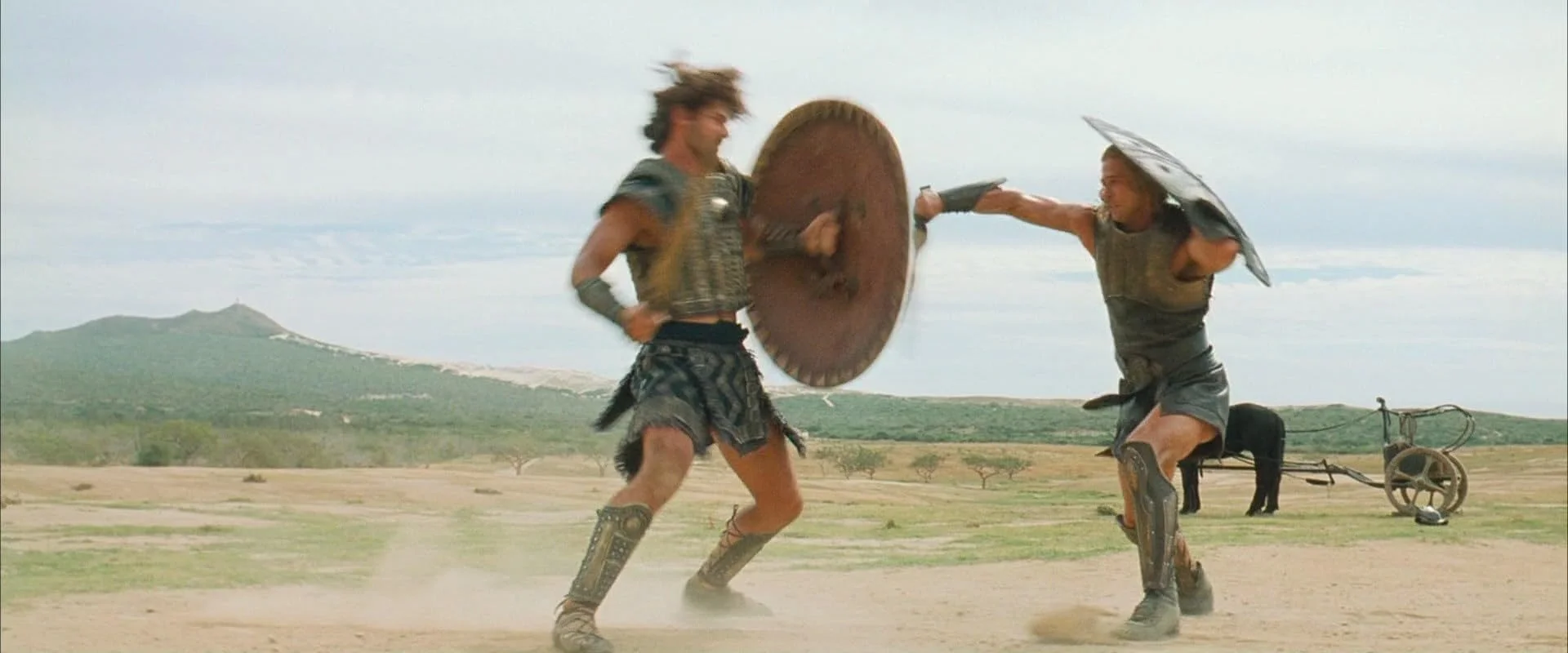
A cinematic masterpiece of a duel between Hector and Achilles in Wolfgang Petersen’s Troy (2004)
Despite its R-rating, The Odyssey has hardly anything adult-oriented. Its fights are laughable and on par with the amateurism displayed in The Dark Knight Rises (2012), boasting the quality of a mid-to-low-tier Netflix flick. The much-anticipated suitors’ massacre-a moment of catharsis that has been building for three hours-is reduced to Matt Damon swinging his axe slowly while weapons are dropped like game power-ups. Nolan’s action is known for its glaring editing mistakes and banal staging since he is more invested in story than set pieces. In an era where John Wick: Chapter 4 (2023) and The Furious (2025) exist, it is embarrassing for a filmmaker of this caliber to deliver such underwhelming sequences. Troy at least understood the need for spectacle, giving us breathtaking battles and duels along with a sensational fighting style for Achilles that explained his status as the greatest warrior of all time.
5. Cultural appropriation
Some ignorant fools say it is a myth. Others say it is fiction, yet neither of them is right. Greek culture has not been lost in time. Its people have existed for roughly 4,000 years and continue to live in the same place, speaking the same (and evolving) language and keeping the same traditions and customs. Articles from Variety refused to understand this, putting out instead headlines about Moana (2026) and the significance of showcasing its culture through accurate representation. It seems that, for a certain group of people, some cultures are treated like sacred cows that must be left untouched. But when the culture that birthed Western civilization (including but not limited to democracy, theatre, drama, poetry, tragedy, satire, philosophy, mathematics, medicine, epidemiology, sports, the Olympic Games, astronomy, mythology) takes center stage, it's an all-time buffet for everyone to dip their toes except the people who live and breathe it daily.
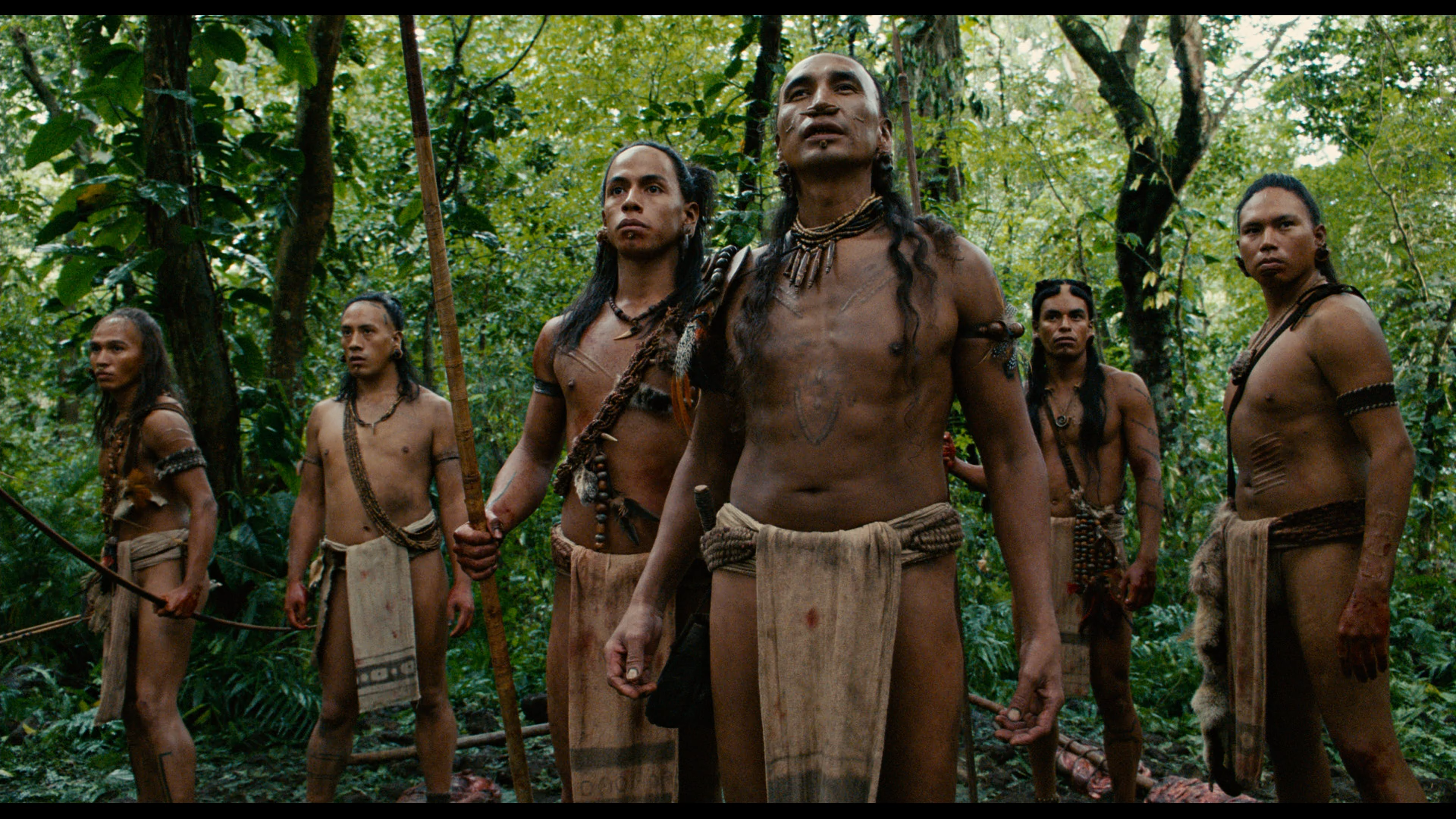
Mel Gibson’s stunning Apocalypto (2006) which kept everything age accurate.
Interestingly, Mel Gibson's Apocalypto (2006) had Indigenous actors who spoke the language of the time, resulting in a smashing hit and three Oscar noms. Nolan had an opportunity to feature a Greek cast but embarrassingly chose everyone else except the Greeks. John Leguizamo has talked endlessly about the lack of Latino roles in major Hollywood productions, throwing shade at actors who played such parts without Latin heritage. Yet when he takes roles from Italians (Super Mario Bros (1993)), dwarves (Moulin Rouge (2001)), and Greeks (The Odyssey), it is okay. Considering how Greek people, or those of the Greek diaspora, have never been cast as the lead not only in a major Hollywood film but also in productions dealing exclusively with Greek myths and tales, you would think that in 2026, we would know better. This ancient world resembles downtown L.A. more than a coherent ethnic group that, unlike most peoples referenced in ancient myth, still exists today, with Asians, Blacks, Latinos, Indians, and Anglo-Saxons visible except for any Mediterranean people. If people are fine with this, that's okay, more power to you. Just remember this the next time there's an adaptation of a Japanese, Korean, or Arabic myth.
6. Helen of Troy and Clytemnestra are twins
Helen was a woman of unparalleled beauty, the face that launched a thousand ships. Having her be a twin with Agamemnon's wife Clytemnestra negates the purpose of Zeus' daughter's mythical beauty-a face famous enough to launch a war single-handedly. Relating these two roles to each other has no effect on the plot, only extending the screentime of Lupita Nyong'o - a brilliant way to waste another role for the sake of provocation.
7. Removing Odysseus’ hubris
The biggest change in Homer’s epic was the removal of Odysseus’ reason for, well, having such a strenuous trip. In the poem, Odysseus told the cyclops Polyphemus that his name was “Nobody.” So when Odysseus blinded him, the other Cyclopes thought no one (a.k.a. Nobody) had hurt him. Once he escaped and boarded his ship safely, Odysseus let his pride take over and shouted his true identity: Odysseus, son of Laertes, king of Ithaca-and thus committed hubris. Little did Odysseus know that Polyphemus was the son of Poseidon, whose command of the raging sea would cost him years of his life. However, true to Nolan’s sensibilities, Poseidon is presented as a mere force of nature that has nothing to do with Polyphemus’ blinding or Odysseus’ arrogance. Nolan simply hints that things happened circumstantially, of course.
8. Odysseus’ post-traumatic stress disorder
Having already removed the catalyst for Odysseus’ trouble, Nolan continues to dissect Matt Damon’s king, who is not keen to return to Ithaca due to lingering PTSD. Willingly, he chooses to eat the lotus flower in order to forget his sins. This dramatic change alters the character from the poem, who, despite ten years at sea, still longs for his wife even while held captive by Calypso. Most importantly, for that reason alone, he does not eat the flower: he is unable to forget his wife, whom he considers his personal goddess because of her impeccable character.
9. Menelaus, the wife-beater
In another attempt to inject modern-day politics, Menelaus-the supreme king of Sparta and a very level-headed man-is portrayed as a generic macho dude with a buzzcut, a role that only Jon Bernthal’s “specific” acting range is capable of filling. The way he interacts with his wife Helen is meant to highlight his violent and abusive personality. Nolan goes further by suggesting he might be the one responsible for scarring her face. Ah, the hubris.
10. Calypso is a hippie nymph
Calypso, the radiant goddess, is portrayed as a homeless hippie. She is not the one forcing Odysseus to stay with her in a giant palace stocked with all earthly pleasures out of lust for a mortal. Instead, she is an anachronistic beach bum missing only a seashell sign reading “make love not war.” Most importantly, in the text, Calypso is selfish like all the gods in Greek mythology. She questions Hermes, who brings Zeus' orders to release Odysseus, asking why the male gods can do as they please with mortal women while she cannot keep a single mortal man. As such, Nolan treats her solely as a passive listener to a stoned Odysseus’ ramblings.
11. The neutered finale
At the end of a 173-minute running time, it is natural to expect that the much-anticipated climactic fight/slaughter will result in Odysseus reclaiming his kingdom with Penelope and Telemachus by his side, just as the poem has it. Taking another unconventional route, Nolan has them live together in voluntary exile, with Telemachus assuming the throne. So after a tumultuous ten-year journey and a ten-year war, Odysseus returns home only to live in exile once more. What should have been a massive cathartic moment on paper-for a hero who has endured vast trials and tribulations to reach his throne and family-is simply not in the finale that Nolan had in his mind.
12. Homer’s text cannot be done justice with another language
Trying to translate (and adapt) a 3,000-year-old poem written in one of humanity’s contextually rich languages (with some estimates of more than 5,000,000 words) into modern-day English (400,000 words) would obviously lose a great deal of emotional, dramatic, and intellectual gravitas. Using that translation as the basis for a screenplay in the same language only dilutes the source material’s written power even further. Unlike other directors who, even when adapting fictional works such as The Lord of the Rings, have maintained a certain level of elevated spoken English, Nolan employs modern-day dialogue delivered in American accents, believing the audience would otherwise be unable to resonate with the story and its characters. Beyond the use of words like “fuck” and “dad,” the inclusion of lines such as “Our Age of Bronze is collapsing upon us” (how do they know they are in the Bronze Age?) and “Let’s get off this fucking beach” marks the famous director as a twenty-something film student from Soho trying far too hard to be edgy.
13. “We are Greeks from Ithaca!”
This immortal line, declared by Himesh Patel (a British-Indian actor)-“We are Greeks from Ithaca!”-when the characters encounter a villager who speaks actual Greek and cannot understand their English (English for the audience, but intended as Greek within the film), is one of the cringiest moments in cinema history. This lack of self-awareness on Nolan’s part will haunt him for years to come.
14. Women roles done badly
Lupita Nyong’o displayed her lack of knowledge when she commented about a poem she had never heard of (unreal for someone in the arts) or read on how Homer would have felt now that this adaptation gives more time to female characters. Such blatant disrespect should perhaps be directed at Nolan’s screenplay, which further limited the key roles of Athena, Calypso, and Circe, and reduced Nyong'o to five minutes of screentime as Helen of Troy and even less as Clytemnestra. Even worse, Pallas Athena, the champion of Odysseus’ return to his homeland, receives only eight minutes of screentime through Zendaya, who plays her as a (potential) projection of Odysseus’ PTSD. Any serious actor would have respectfully declined.
15. The condemnation of heroism
“Nolan’s ‘Odyssey’ lacks many of the elements that make the poem great. It has nothing convincing to say about time, memory, history, war, or about the relationship between one warrior’s glorious return and the lives of his family, adversaries, comrades, friends and neighbors. It lacks psychological, emotional, political and ethical depth. Its narrative structure is gimmicky. The writing is abysmal. ”
The Odyssey, like the Iliad, is filled with heroism (a Greek word describing deeds of valor and virtue). Yet this quick-witted, cunning, and fun-to-hang-out-with Odysseus is a drag. The protagonist of this truly epic tale, along with his eventual triumph against all odds (human, monstrous, and supernatural), should be someone we all aspire to be: a loyal husband and father, a sharp warrior, and a brilliant strategist who, due to his own hubris, embarked on this perilous adventure. Nolan, unable to understand the meaningful heroism behind such a legendary character, desperately tries to decipher his personality the way an AI program tries to feel the wind or the warmth of the sun. In an ironic twist of fate, Emily Wilson-whose Odyssey translation boasted a more… modern take on the Greek words - spoke to Variety and called his script “abysmal,” saying, “I would be ashamed to have written any part of this script.” Case rested.