
In 2026, we saw the biggest fighting games in mankind’s history (Midway’s Mortal Kombat (1992-present), Capcom’s Street Fighter (1987-present)) battling on who will get the biggest share of box office revenue. Interestingly enough, neither had a plethora of movies to their belts. Street Fighter started early in 1994 with two films. One was an anemic live action adaptation with bad reviews and healthy ticket sales. The other was a Japanese animated flick called Street Fighter II: The Animated Movie which was a critical and commercial success bringing ~$30 million from a $6 million budget. Despite the solid box office though, Street Fighter won’t have another entry till The Legend of Chun-Li (2009), a misconceived atrocity of DTV aspirations.
Meanwhile, Mortal Kombat reigned supreme in 1995 enjoying commercial and (some) critical success (i.e., Gene Siskel was a big fan), a generous fan reception and an awarded cult status decades later demonstrating that films based on videogames could work for both newcomers and gamers alike. Yet, its momentum was squashed by the disastrous (and more expensive) sequel, Annihilation (1997), which ostracised the franchise to TV oblivion (e.g., Mortal Kombat: Conquest (1998-1999)) until a gritty reboot in 2021 and its sequel, Mortal Kombat II (2026).
With the release of a new Street Fighter (2026) movie attempting to win audiences, it is time to square off these two franchises against each other, cinematically of course and explore which is the king in the rather low bar of multiple videogame adaptations.
1. Mortal Kombat: Annihilation (1997) Vs. The Legend of Chun-Li (2009)
Both franchises have reached the lowest pits of cinema hell, but which one is truly the worst of the worst? Annihilation or The Legend of Chun-Li? While Annihilation is a terrible picture, it works brilliantly as a comedy. Exaggerated wire-fu? Check! Bad casting choices? Check! Noticeable goofs? Check! Deadly serious tone? Check! Nevertheless, it does have scope shot around the world (LA, Thailand, Wales, Jordan, Israel), Smoke and Cyrax look cool, and the (very repetitive) soundtrack manages to occasionally wake the audience up. The Legend of Chun-Li has, unfortunately, none of these things. Its fights are piss-poor, the characters have been butchered (RIP Vega and Bison), Chris Klein’s acting is awful, the game’s mythology has been stripped clean to favor real estate business(!) and Kristin Kreuk looks nothing like Chun-Li.
2. Box office breakdown
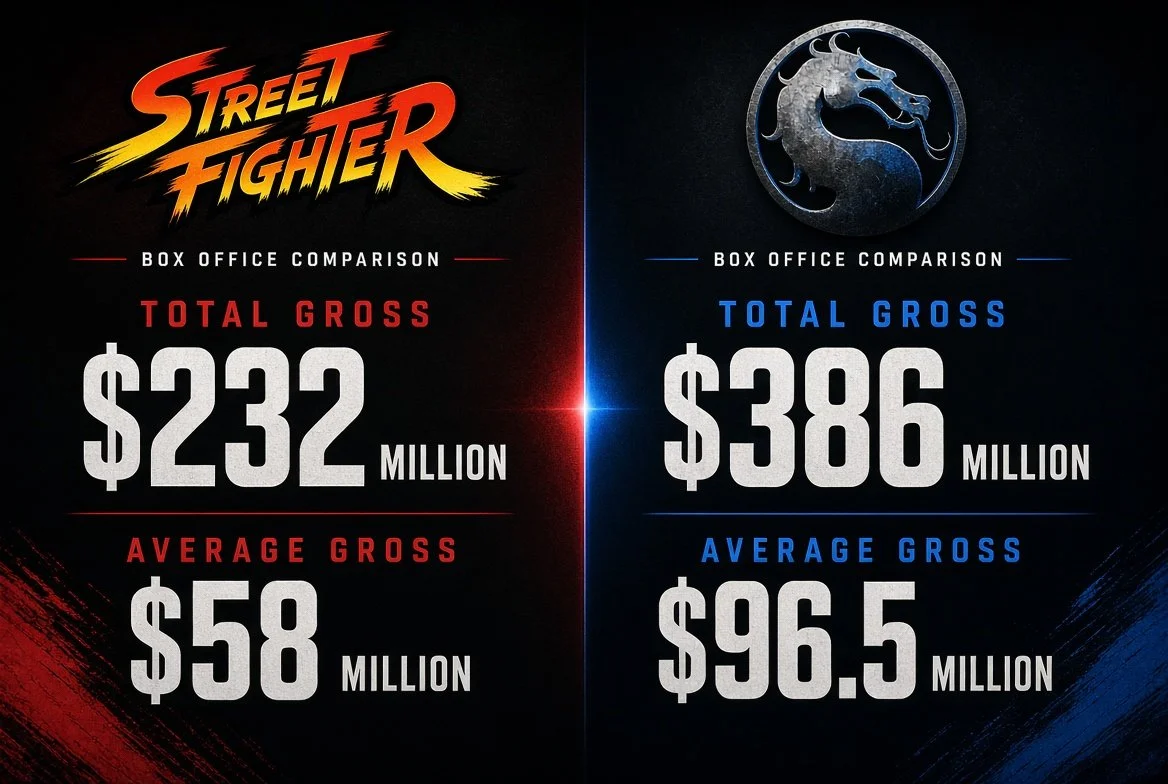
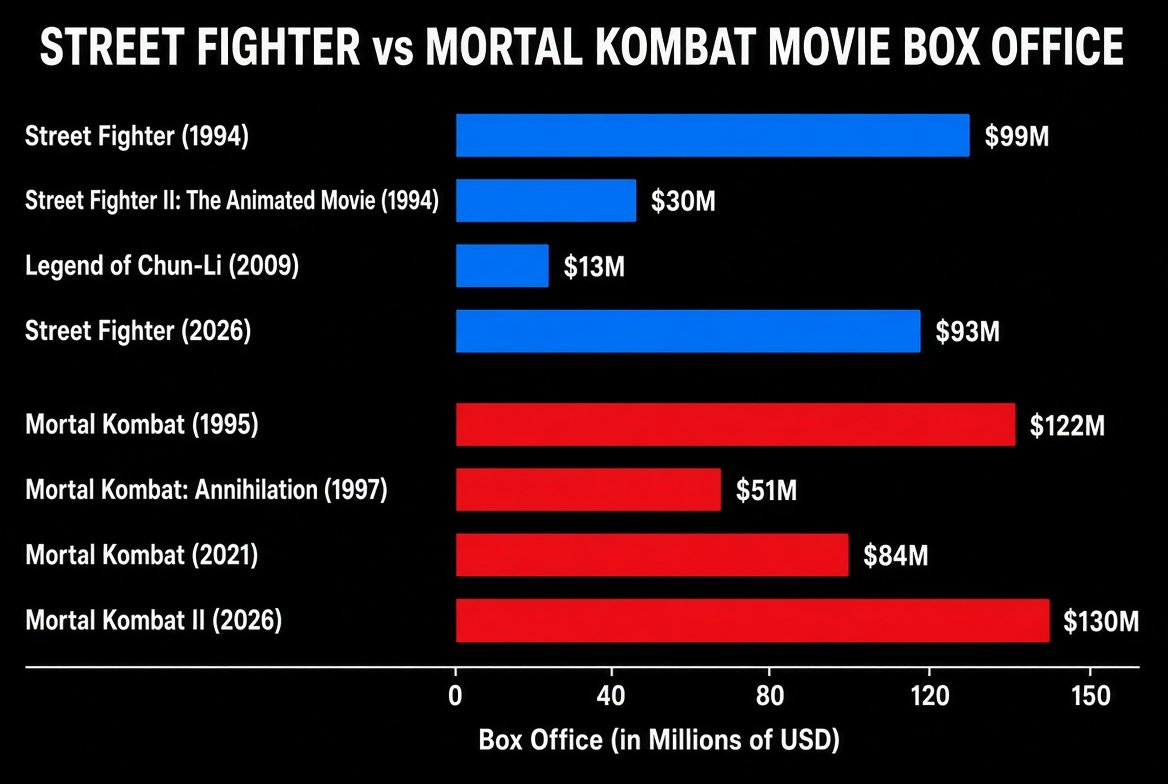
It is possible that things can improve after Street Fighter (2026) finishes its theatrical run.
3. Critical and fan reception
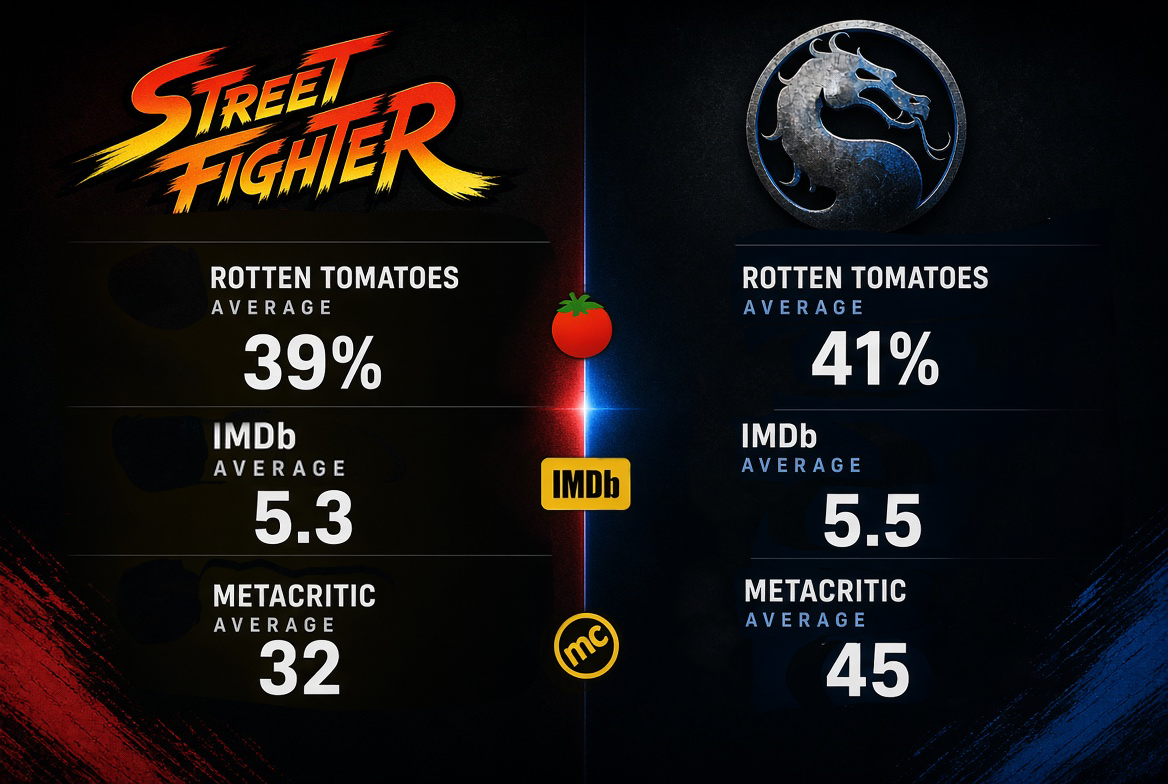
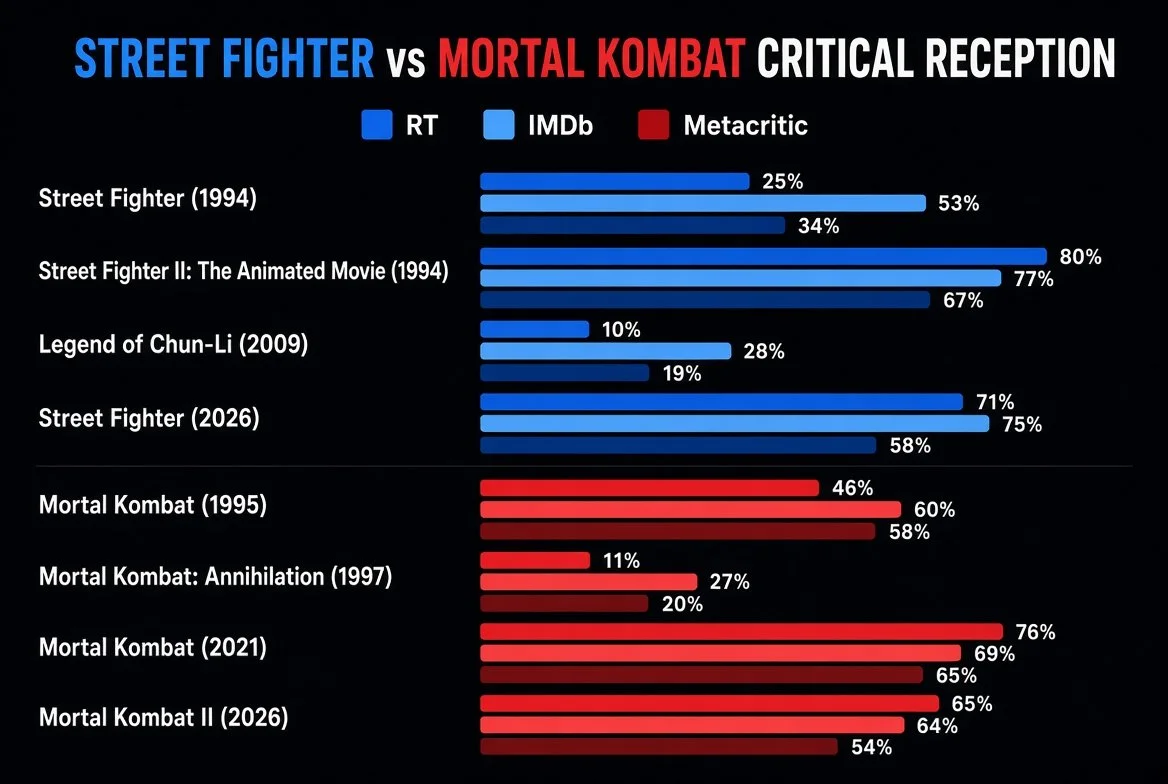
Neither franchise has been a critical darling. In (the not so reliable) Rotten Tomatoes, both have roughly the same average score (41% for Mortal Kombat; 39% for Street Fighter), one fresh (Mortal Kombat II at 63%; Street Fighter II: The Animated Movie at 72%) and one panned entry (Mortal Kombat: Annihilation at 4%; The Legend of Chun-Li at 3%). Taking into account IMDb, things improve slightly with above average scores (55 for Mortal Kombat; 53 for Street Fighter).
4. Fights
The meat of both series. Structured around tournaments that either decide the best fighter or the fate of the world, it is inevitable for their on-screen adaptation to feature martial arts sequences. The first Mortal Kombat endures the test of time. Being the first American production to employ successfully wire-fu, its fights are among the best Hollywood had to offer with aggressive stuntwork and Hong Kong-inspired choreography shot competedly by Paul WS Anderson in his American debut. Annihilation two years later dropped the ball with its wire-fu abuse and while the reboot attempted to be more visceral, it failed due to choppy-happy editing and stale staging, a trend that continued in the only marginally better Mortal Kombat II.
Meanwhile, Van Damme’s jumping spinning heel kick had lost its initially, jaw-dropping appeal. Street Fighter’s action was basic at best due to a plethora of production problems (e.g., lack of prep time, no martial arts actors, Julia suffering from cancer during the shoot). Consequently, characters with unique fighting styles are completely wasted. When Guile squares off with Bison, there is some form of entertainment but it is more memorable due to Julia’s grandiose line delivery (e.g., “For I beheld Satan as he fell from the sky like lightning!”). The Legend of Chun-Li seeks to stage realistic fights with terrible editing and amateur style and the 2026 entry offers some rectification of the past’s grievous mistakes even if its fights are brief. For a Street Fighter film, the mano-a-mano should be deliciously long and visceral. Thus, we are left with the animated standalone film that does a convincing job at illustrating the powers of Bison, Guile, and co whose highlight is furious and legendary fight between Vega and Chun-Li remains legendary.
5. Cultural impact
“Moooooooortal Kooooooombat”. One yell and some fiery opening credits cemented the original Mortal Kombat into the pop culture atmosphere. From its soundtrack to its fantastic presentation, Mortal Kombat mania was everywhere especially after the lame attempts of Super Mario Bros. (1993), Double Dragon (1994), and Street Fighter. Mortal Kombat showed how a videogame adaptation can treat the source material with respect simultaneously appealing to newcomers and fans alike. This lightning-in-the-bottle resulted in canon rectification for characters like Kano and Shang Tsung, the latter becoming a de-facto 90s villain with his legendary quotes. Influencing the way American martial arts movies present themselves (e.g, The Matrix (1999)), Mortal Kombat’s cultural mark is undeniable. The same cannot be said for its next three follow ups though. One killed the franchise completely and the other two merely exist as shown from their lukewarm box office receptions.
Street Fighter, on the other hand, still struggles to be relevant since the people behind the camera are not that invested in its rich mythology. Besides the original obtaining also a cult status due to its goofy tone, questionable casting choices, and OTT villain, the rest of the live action adaptations are nothing to write home about. While the animated movie accurately follows the lore of the game, it felt more of a small scale TV episode than a standalone film.
6. Soundtrack
Only one of these two franchises has been linked to a peak 90s anthem and that is Mortal Kombat. Its theme song was composed by The Immortals capturing the imagination of every 13-year-old boy who happened to see the film. The album features some mental choices for its fight sequences (e.g., Napalm Death, Juno Reactor, Fear Factory!) while the complementary score by George S. Clinton went full hybrid with its taiko-techno-orcho approach. Like most criteria, Mortal Kombat’s next three films did not have the same influence its charming predecessor did.
Street Fighter had a solid militaristic driven score by Kiwi Graeme Revell, its soundtrack though remained uninspired. The animated movie did boast some cool tracks by KMFDM and Korn and original compositions but these did not reach the cultural significance that Anderson’s movie did. And since The Legend of Chun-Li has nothing to go for it, it is a pleasant surprise to see the vibrant reboot having a memorable score, considering how overlooked music composition has become in the Hollywood. With two tracks by metal band, Health, and various 90s bangers ranging from White Zombie to Offspring being introduced to a new generation of moviegoers along with Leo Birenberg’s and Zach Robinson’s catchy 80s inspired industrial beats, Street Fighter has a unique musical identity that so many modern films this time don’t have.
7. Heroes
Liu Kang or Ryu? Johnny Cage or Ken? Kitana or Chun-Li? Undeniably both film series have massive rosters of heroes from all sorts of martial arts, national, and ethnic backgrounds. It is though the actual translation of them on the big screen that will decide the winner. In the Kombat corner, we have the pitch perfect casting of Robin Shou’s as Liu Kang, Linden Ashby as the cocky Johnny Cage, Christopher Lambert as a mentor who is not being deprived from a wicked sense of humor and Adeline Rudolph’s Kitana from the last movie, who has the most important arc.
Street Fighter boasts the recent and excellent casting of Andrew Koji, Noah Centineo, and Calina Yang as Ryu, Ken, and Chun-Li respectively with all three making strong impressions. However, despite their sexy appeal, they are not enough to eclipse the iconic chemistry between Ashby and Shou who, in particular, gives a strong physical performance. Be that as it may, Street Fighter still does not have its own version of Raiden. Lambert’s charisma was undeniable bringing some gravitas to a pretty silly sounding movie with his deep, raspy voice and deadpan humor. Mortal Kombat wins.
8. Villains
Villains are always the best part in a videogame and both Kombat and Fighter do not disappoint. Just like with their heroic counterparts, there is a large selection of all sorts of antagonists: cyborgs, ninjas, megalomaniacs, sorcerers, assassins, enforcers, warriors, gods, and more out for blood, vengeance, or world domination (among other goals). Nevertheless, almost all adaptations are using the main villains in the games’ storyline without deviating too much in the antagonist department (Shang Tsung, Shao Kahn with minor work from Sindel, Kano, and Subzero for Kombat; M.Bison, Vega, Sagat, Akuma, and Balrog for Fighter).
Mortal Kombat includes the de-facto representation of Shang Tsung, a villain that manages to find another day to fight Earth’s greatest champions. Cary Hiroyuki-Tagawa became synonymous to the role of as the shape-shifting sorcerer Shang Tsung, immortalized now in the pop culture pantheon for his acting, line delivery, and unique facial expressions. He imbues Shang Tsung with a small layer of humanity that for such an overpowered antagonist feels unnecessary but that makes him all the more … mortal. His extended face-off with Shou’s Liu Kang is one for the ages justifying himself as the final boss. While Brian Thomson’s Shao Kahn comes across as cartoony, the towering Martyn Ford was a much more inspired choice thirty years later getting the lion’s share of fights in Mortal Kombat II even if his presence gets diminished with that shoddy CGI.
On the other hand, Street Fighter boasts the last role of the great Raul Julia, a Puerto Rico thespian who created his own version of M.Bison and devouring the entire scenery while doing so. Camp and larger than life with correct comic timing, his M.Bison is on the joke outclassing Jean Claude Van Damme and taking the audience to his side. The animated film does portray Bison and his minions more faithfully though especially Vega’s narcissistic and sadistic personality which the 2009 and 2026 movies fall short. David Dastmalchian’s goofy creepiness is not enough to a role that requires an imposing superiority while Vega and even worse Sagat, have no material to work with. At least, Akuma makes his first appearance on the big screen as an unstoppable force of nature despite a handful of scenes.
As such the combo of Tagawa’s acting in a delicious role with Ford’s towering frame and lots of screentime manage to defeat Julia’s OTT masterclass since he is not (at least in the live action department) supported by anyone else.
9. Presentation
Street Fighter has, across three films, a more grounded look. The Legend of Chun-Li tries to flirt with gritty realism (heavily influenced by the success of Christopher Nolan’s The Dark Knight a year prior its release) toning down any fantastical elements and even the nature of the tournament itself while the 1994 original adopted the expansive look of a war movie removing special moves (e.g., psycho power, fireballs, Dhalsim’s stretching abilities). So it is up to the vivid reboot to go full 90s excess in its overwhelming visuals. Saturated colors, game-accurate costumes (call me Cammy), unapologetic usage of special moves, and arenas lifted straight from Street Fighter 2 (1991) gives the reboot a unique style from Netflix productions and other direct-to-streaming garbage.
In Kombat territory, only one movie thought to unwisely rewrite the established mythos into cookie-cutter fantasy visuals. While its sequel attempted to rectify this mistake, it felt cheap with no atmosphere. The same thing cannot be said for what the filmmakers attempted to do with the original Mortal Kombat movie. The Babylonian sets brought Shang Tsung’s island and the perilous Outworld to life with an exquisite amount of detail. Each scene boasts something new and never feels cheap. Even if the sequel felt rush, there is a sense of maintained scope (despite having less conviction).
So it is really down to the original movie vs the modern Fighter reboot but Kombat’s unique atmosphere capture is appealing to this day. John F. Leonetti’s cinematography gives the film a distinct and most importantly, convincing look with the otherworldly atmosphere felt at every frame.
Conclusion
With nine clean wins, the on-screen adaptations of the Mortal Kombat games win. Street Fighter has an excellent animated entry to its catalogue, a truly theatrical performance by Raul Julia, and an honest and easy-going reboot that captures the spirit of the arcade game. Yet, Mortal Kombat has a soundtrack that transcended decades, an appealing presentation, better critical reception, higher box office revenue, better fights (even when it takes a massive plunge in quality), better acting and a legendary villain in the face of Tagawa. Perhaps in a few years time, when someone takes another crack in Street Fighter, its chances would be improved. But not today. Flawless victory for our Kombatant.